Slow living in Bologna - the historic gem between floral boutiques, antique shops, bookstores, street food and the art of bon vivre
I.
Between Heritage and Daily Life
Some may think of slow living as a philosophy, but it is something that has more to do with practice than with theory. It is a lifestyle focusing more on quality than quantity, implying the very core of leisure lies in how much time we are willing to give to what we truly appreciate. The city of Bologna persuaded me how attainable this vision can be.
Against the backdrop of an old city center that holds a strong historical heritage, smoothly navigable by bike, a mosaic of well-preserved medieval, renaissance, and 19th-century architecture unfolds. Within a few hundred meters the Complex of the Seven Churches, an extraordinary ensemble of Early Christian, Romanesque and Gothic architecture, while a few steps away soars the medieval Torre degli Asinelli - nearly 100 meters of bricks, and the Basilica di San Petronio, one of Italy’s grandest religious architecture.
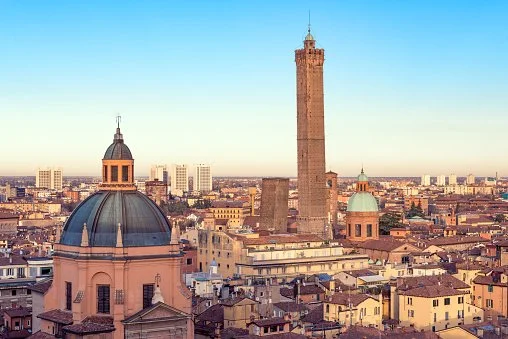
Bologna, aerial view
Amid this heritage the lives of enthusiastic university students unfold, since the city is home to one of the world’s oldest universities. The culinary artistry pervades the city - still, honestly, far from an overly tourist-driven approach. Today this fusion of lively social energy and centuries-old urban history can be seen in the hangouts, beneath the typical arcades (portici). They are part of the UNESCO World Heritage list. Across their 62 kilometers the picturesque passages are each characterized by wooden or stone columns, vaulted ceilings or brick-lined walls, time-worn house doors and shops.
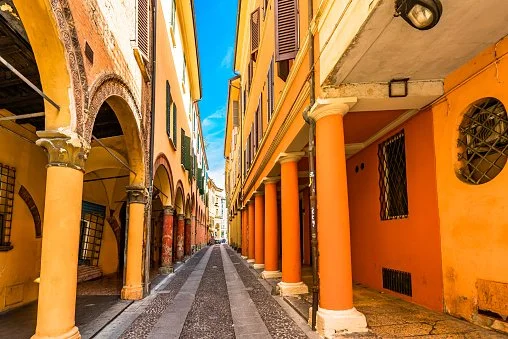
Bologna Typical Porticoes
II.
Italian Rituals
They range from design shops to herbal shops, from literary cafés to traditional taverns, from modern bookstores to antique dealers - many of which hold real hidden treasures. A true local tradition that leaves to the visitor the joy of discovering everything, from carpets and porcelain and furniture, paintings, vintage toys, LPs and books. Besides the well-known antiques market that is held in the city center every second Sunday of the month, several antique dealers are located in Via di Santo Stefano and Strada Maggiore.
A widely celebrated hallmark of Italian culture, the caffè espresso is a ritual that helps mark the moments of the day. In Piazza Galvani, once the site of the silk market, the colorful tables of the historic Caffè Zanarini - operating since 1930 - extend from the porticoes of the monumental Palazzo dell'Archiginnasio to the square. A few hundred meters away the Antico Caffè Scaletto is an intimate and charming bar open since 1921 and recently renovated in retro style: the buffet is always filled with miniature pastries. Since 1907, the Caffè Gamberini has been a landmark beneath the arcades, keeping the charm of the last century and Caffetteria Terzi, born in 2002 in the premises of an old wine tavern, is entirely dedicated to coffee, from selection to processing, becoming a meeting place for fans of the Italian tradition of caffè espresso.
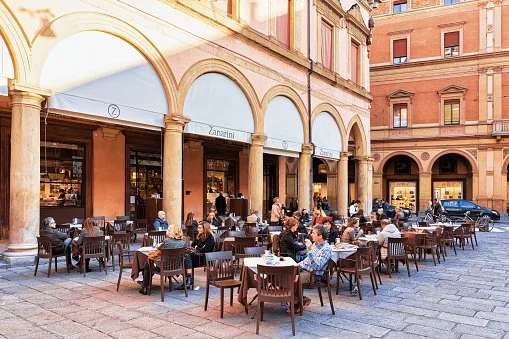
Piazza Galvani dehors
III.
Inspired by Beauty and Culture
Their decorative and symbolic value has long inspired art: plants and flowers, in expert hands, can be transformed into ephemeral living jewels. In the old city center it is quite common to find small shops where florist-artists compose true works of art and signaling their presence through joyful displays of their window display in the historic centre. They hide in the narrow streets, such as Frida’s on Via di Santa Margherita, Fleur d'Âme on Piazza Minghetti or Quadrilatero Fiorito, on Via Drapperie. During spring and summer Bologna hosts two traditional events dedicated to plants and flowers: in April Piazza Minghetti hosts an exhibition of trendy plants and flowers - from roses to aromatic herbs - while during May and September the Giardini Margherita is the venue for a large exhibition of flowers, a real festival of greenery.
While reading is a purely solitary activity, bookstores are, conversely, place where to meet other passionate souls, immersed in a kaleidoscope of books. The Palazzo dell'Archiginnasio, the former seat of the University, houses the large Coop Zanichelli Bookshop which stocks catalogues of the main Italian publishers, while a few steps away the Stoppani Library is mainly dedicated to literature for young readers and features many illustrated books. Hidden in the side streets there are several small bookstores, such as BAAK and Trame, that enthusiastically host literary cafés or thematic events. Alternatively, on weekends, you can enjoy a daily poem at Il Libraccio bookstore.
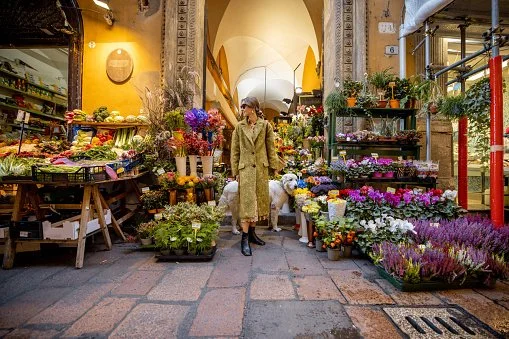
Florist shop in the city center
IV.
Savoring the City
Personal taste, technique or tradition, food is a hot topic. The Italian culinary tradition is no exception: from the slow living perspective some include street food - provided it respects some fundamentals, such as the choice of local produce and the fidelity to traditional recipes. Others might point out that it is born to be eaten on the go, can deprive the experience of quality. Whatever your opinion, during a stroll through the arcades and streets of the old town it is hard to resist sampling the traditional local cuisine, for which the city is famous worldwide: from fresh tortellini, to aromatic tagliatelle al ragù, to the intense scent of mortadella.
Street-food alternatives are numerous: MortadellaLab enhances the traditional mortadella in different combinations of seasoned rosetta, just as Ragu does the same for the iconic sauce. If in doubt, Mercato di Mezzo is an indoor food court bringing together a curated selection of traditional cuisine. Committed to the Slow Food principles, the small Trattoria di Via Serra preserve an original Emilian atmosphere in both the environment and recipes - even with a simple dish like their ricotta-filled tortelloni. While at Osteria Bottega the emphasis is on elevating traditional dishes with meticulous care and demonstrating that tradition and innovation can coexist.
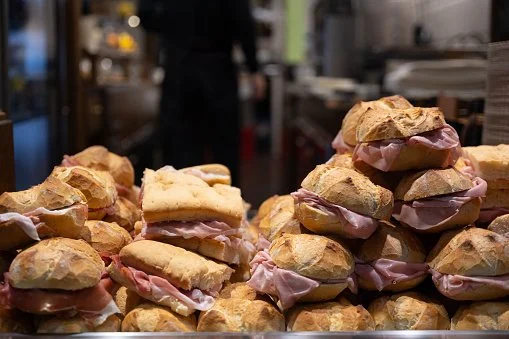
Rosette with Mortadella – Bologna Delicacy
V.
A place to return to
After all, to truly get to know a place so rich in history, more time is needed. And just like its layered past, this is only a starting point. The richness of the city runs deeper: in its museum, historic buildings, and in the visible traces of time that can still be read across its streets and walls. In Bologna, artistic and cultural life are alive in every corner of the city, doesn’t ask you to slow down, but rather to live more intensely. It’s this reflective intensity that invites us to pause, to deepen, to discover.